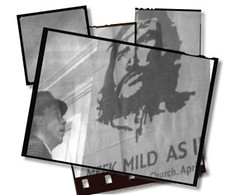
HT: Dan from PoserorProphet
"It is also crucial to bear in mind the interconnection between the Decalogue... and its modern obverse, the celebrated 'human Rights'. As the experience of our post-political liberal-permissive society amply demonstrates, human Rights are ultimately, at their core, simply Rights to violate the Ten Commandments. 'The right to privacy' -- the right to adultery, in secret, where no one sees me or has the right to probe my life. 'The right to pursue happiness and to possess private property' -- the right to steal (to exploit others). 'Freedom of the press and of the expression of opinion' -- the right to lie. 'The right of free citizens to possess weapons' -- the right to kill. And, ultimately, 'freedom of religious belief' -- the right to worship false gods."
The Fragile Absolute -- or, why is the christian legacy worth fighting for?
Sunday, August 06, 2006


Tuesday, August 01, 2006
One Book Meme
One book meme
Ben started a new meme with a post a while back, since I have been gone for a week I just noticed it, and I thought I would pick it up:
1. One book that changed your life:
Tom Wrights, New Testemant and the People of God (1996)
I read this in my first year of post graduate studies, and it completely changed my outlook on New Testament studies, it opened my mind.
2. One book that you've read more than once:
John Irving, A Prayer For Owen Meany (1997)
I read this book whenever I am struggeling with faith and belief, Owen always makes me want to believe again.
3. One book you'd want on a desert island:
Karl Barth, Dogmatics (2004)
I am not sure if this is fair, but who knows when I will be rescued!
4. One book that made you laugh:
Bill Bryson, Notes from a small Island (1997)
Bryson describes a beach holiday to perfection!
5. One book that made you cry:
John Irving, A Prayer For Owen Meany (1997)
6. One book that you wish had been written:
Tom Wright, Pauline Theology (2xxx)
7. One book that you wish had never been written:
Tim LaHaye and Jerry B. Jenkins, Left Behind: A Novel of the Earth's Last Days (1995)
8. One book you're currently reading:
Kurt Vonnegut, Galapagos(1986)
9. One book you've been meaning to read:
George A. Lindbeck, The Nature of Confession (1996)
10. Now tag five people: This is the part that never seems to work with memes - Take a shot Blue
Thursday, July 20, 2006
The Life of Pi Redux

Don't read this if you plan on reading the book and you don't want spoilers!
Dan asked me what my take on the Life of Pi was? So instead of burying it in the comments I thought I would post about it.
Like I said before the Life of Pi is a book that pays huge dividends upon completion, and upon reflection. It is a book that claims to make you believe in god. While that is a bold claim, which depending upon ones own constitution may or may not be true, it will certainly make you reflect upon the divine.
The claim itself made me have high ambitions for the book, not because I believed it, but rather because it reminded me of the opening of my favorite book, 'A Prayer for Owen Meany', the narrator of that book claims that it was Owen who made him believe in god, and to be honest, A Prayer for Owen Meany was a book that helped me regain my faith in a time of doubt, so I was hoping that Pi would be an equally powerful narrative.
It was a powerful story and it will make me think and reflect for days to come, but if I were to succinctly give my take on the book, I think the message is about the power of stories to influence and even sustain faith. The book never mentions the 'truth' of the divine, and that will bother a lot of people who think that truth is the beginning and end of religion. And it reduces the religious life to living out better stories, stories of hope, stories of redemption, stories of survival, rather than living out stories that are cold and materialist (in the technical sense), but that's not a bad reduction. What one needs to live out these better stories is an imagination that itself is empowered by faith. So the novel has a lot to chew on.
There are some killer themes in this book in regards to language, truth, and of course stories. These themes when dealt with in a novel are always riveting to me, and that is part of why I enjoyed the novel, but even if you don't get into these themes the book is still worth a read.
On Tradition:
"But we should not cling! A plague upon fundamentalists and literalists!"
This quote reminded me of the seminal work by Fishbane on Ancient Israel. Fishbane's main point was to show how the traditions of
On Language:
"Doesn't the telling of something always become a story? ...Isn't telling something - using words - already something of an invention?...The world isn't how it is. It is how you understand it, no? And in understanding something we bring something to it, no? Doesn't that make life a story?”
Yes it does Pi, Yes it does.... "And so it goes with God."
Thursday, July 13, 2006
Why a Ph.D. takes so long...

Back when I was in Sheffield I remember at a seminar Prof. Loveday Alexander mentioned how she thought that the proper paradigm for the parting of the ways was mostly captured by Boyarin's account. I sat there and nodded my head, as I often do when things only partially register, whilst my brain raced trying desperately to connect the name Boyarin with the books that I had recently read. I had remembered one on Intertextuality and Midrash, and perhaps something about a radical Jew, but nothing on Christian origins. So I determined to find Boyarin's book on Christian origins, as soon as the seminar was over, but I suspect the sirens at the Devonshire Cat were calling that day, and by the second pint all thoughts of getting any serious work done were well behind me.
Well good news I have finally tracked down Boyarin's book on the subject, it only took me two years. Who said efficiency is part of the Ph.D. process anyway? Well I plan on posting some thoughts on the parting of the ways after I tuck into this little gem.
Oh, you just want me to give up the name of the book when I worked so hard for it!
Ok then I am feeling nice:

Subscribe to:
Posts (Atom)