Sunday, August 26, 2007

The Concept of Exile during the Second Temple Period: Part 5 Josephus

The evidence of a continuing exile from Josephus
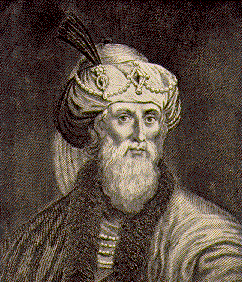
Although the writings of Josephus for the most part downplay the historical exile to Babylon and at times over emphasize the positive attributes of how Jewish people can contribute to their alien environments, coupled with the fact that Josephus himself spent the last three decades living in luxurious exile in Rome, it is not surprising that he does not emphasize restoration.[1] Josephus, however, does speak of two separate instances where certain Jews who claimed to be sign prophets promised their followers signs of coming salvation; Theudas and the Egyptian.[2]

Theudas came upon the scene during the reign of the procurator Fadus (44-?46 c.e.), he most likely was responding to friction arising over a dispute about who controlled the vestments of the High Priest.[3] Although Josephus calls Theudas an impostor, Theudas convinced his followers to take all of their possessions and to follow him to the Jordan River where he promised that upon his commanded the Jordan river would part allowing his followers to cross. Fadus however sent a squadron of cavalry and took Theudas’ group by surprise, capturing most of them and beheading Theudas on the spot. The head was displayed around Jerusalem to discourage other would be prophets.[4]

Thaedus’ intentions of parting the Jordan river, strongly evokes the re-enactment of the first exodus, by associating their actions with the splitting of the Re(e)d Sea (Ex. 12.29-14.30) and the Jordan river (Josh. 3-4), this group may have thought they were enacting the Isaianic second exodus thus bringing about the end of the exile by ridding the Jews of their foreign yoke and partaking of the land promised to them.

Josephus’ account of the Egyptian is part of a longer narrative summarizing the events of Palestine under Felix, who was procurator from 60-52 c.e.[5] Like Theudas, Josephus calls the Egyptian a false prophet, but by Josephus’ own estimation the Egyptian seemingly garnered a much wider following.[6] Although there are discrepancies in Josephus’ own accounts of the Egyptian, in the Antiquities Josephus tells us that the Egyptian first came to Jerusalem and raises a following there, the mass then marches from Jerusalem to the Mt. of Olives, outside the city walls, and there the Egyptian claimed that the walls would miraculously fall down at his command, allowing his followers to enter, and probably enact an armed invasion of Jerusalem.[7]

Here too the Egyptian modeled his actions upon the events surrounding the first exodus, namely in a re-enacting of the original entrance into the Promised Land by the defeat of Jericho by Joshua, by claiming to bring down the walls of Jerusalem. The Egyptian was most likely expecting divine intervention to help them in this new defeat of the Romans and in ridding the land of the political oppressors.[8]

Evans suggests both of these ‘prophets’ were probably laying claim to the promises in Deuteronomy 18.15-22 that someday God would ‘raise up a prophet like Moses.’[9] The promises of Isaiah 40 might have also contributed to the actions of the “prophets” to start in the wilderness thus drawing continuity between their own actions and the “high way” of God in the second exodus.[10] Because these signs recalled both the exodus and the conquest they were almost certainly meant as eschatological signs.[11] There is little doubt that in both of these cases some sort of restoration was still pined for, and the fact that both events were modeled after the events surrounding the first exodus gives credence to the idea that a new exodus from exile must have still resonated with many Jews, for it is unlikely that these two men would have collected ‘masses’ of followers, if there was a general consensus that the restoration was complete and thus the exilic experience was over.[12]


[1] Louis H. Feldman, "Restoration in Josephus," in Restoration: Old Testament, Jewish, and Christian Perspectives, ed. James M. Scott (JSJSup 72; Leiden: Brill, 2001), 226, 29.

[2] The account of Theudas is found in Ant. 20.5.1, 97-98; and the account of the Egyptian Jew is found in JW 2.13.4-5, 258-263; Ant. 20.8.6, 167-172.

[3] Rebecca Gray, Prophetic Figures in Late Second Temple Jewish Palestine: The Evidence from Josephus (New York: Oxford University Press, 1993), 114-15.

[4] Gray, Prophetic Figures, 115.

[5] For the larger narrative see, JW 2.13.4-5, 252-265; Ant. 20.8.6, 160-172.

[6] In Acts 5.36 Gamaliel 1 claims that Theudas had about 400 followers while Josephus cites that Theudas was able to convince the ‘majority of the masses.’ This is contrasted with Josephus account of the Egyptian in JW where he claims the followers to be in the 30,000 range.

[7] On the possible reasons for the discrepancies between JW and the Ant. see Gray, Prophetic Figures, 116-17.

[8] Gray, Prophetic Figures, 119.

[9] Craig A. Evans, "Aspects of Exile and Restoration in the Proclamation of Jesus and the Gospels," in Exile: Old Testament, Jewish, and Christian Conceptions, ed. James M. Scott (JSJSup 56; Leiden: Brill, 1997), 303.

[10] Craig A. Evans, "The Beginning of the Good News and the Fulfilment of Scripture in the Gospel of Mark," in Having the Old Testament in the New Testament, ed. Stanley E. Porter (McMaster New Testament Studies; Grand Rapids: Eerdmans, 2006), 101.

[11] E. P. Sanders, Jesus and Judaism (Philadelphia: Fortress Press, 1985), 171; Richard A. Horsley, Christian Origins (A People's History of Christianity 1; Minneapolis: Fortress Press, 2005), 30.

[12] Horsley, Christian Origins, 29. Josephus may have used these instances to reassure the Romans that he supported the swift action taken against these false prophets, but nevertheless these ‘rebels’ were able to garner popular support precisely because exilic notions still prevailed. See Steve Mason, Josephus and the New Testament (Peabody: Hendrickson, 1992), 110.

Thursday, August 23, 2007

Homi Bhabha


Communication is always a process

that is never perfectly achieved

and that there is always

slippage,

a gap,

between what is said

and what is heard.


Saturday, August 18, 2007

The Concept of Exile during the Second Temple Period: Part 4 Qumran

The evidence for a continuing exile from the texts of Qumran.

Probably the least controversial group of texts that speak of the potency and power of exilic ideas and restoration are those texts discovered in the Dead Sea.[1] While the concepts of exile and restoration are prevalent at Qumran, they oscillate between the restoration of the land of Israel, the restoration of Jewish people, the restoration of the temple, and the restoration of sacrificial worship, and restoration to a ritual purity and perfection.[2] Furthermore it is often hard to distinguish from the concept of restoration and the overlapping concepts of remnant, eschatology, and messianism. Such fluidity found within these texts ensure that any evidence given for continuing exilic thought must admit to only being a partial picture of the texts and certainly nothing like a theology. [3]

That being said the texts found at Qumran do show that the community[4] itself may have been modeled after the exodus traditions.[5] With this insight it can be readily appreciated just how central the theme of exile was to the authors of the Qumran manuscripts. Martin Abegg, Jr. states that:

While the sojourn in Egypt and exile of the northern tribes was still reflected in the writings, it was the Babylonian exile which had captured the corporate imagination. In a very real sense it had become a new paradigm which spoke of how god dealt with his people Israel. The new going down to Egypt was the deportation to Babylon in fulfillment of God’s warning of Judgment (CD 7.9b-15). The return was followed by an important albeit unknown event which led to a lengthy wilderness wandering (1QS 8.12b-14)—the new Sinai—so as to prepare for the coming of God. The New Moses was the Teacher of Righteousness. The Faithful then waited for God to bring them into the land of promise—the iniquity of the Amorites not yet being full—and establish them in their rightful place (4Q171 1-10 ii 26-iii 2).[6]

It is possible that the Qumran community believed that it was already living in the eschaton (cf. CD 1.12), and that the eschatological salvation was, already present and able to be found by following the Teacher of Righteousness whom God had raised for this purpose.[7] The Damascus document gives the impression of a community which thought of itself as the continuing faithful remnant of returnees from the Babylonian exile (CD 7.20-8.2). By framing the eschatological beliefs in the ‘historical’ return from exile it could be argued that the community themselves thought that they were indeed the first-generation of the 'new Israel' to return from exile.[8] In fact when the Damascus document speaks of the returnees (CD 3.21-4.4) it ignores the historical return of Ezra, Nehemiah, and Zerubabbel, since in the sect’s eyes the exilic period would continue until the sectarians took control of the Temple’s ritual at the end of days. In other words the restoration is not an event that had already taken place in the Persian period, but rather a part of the eschatological future being played out already in his own day.[9] Although the texts make reference to the restoration as in the process of happening, this was still only a kind of prototypical return in which they modeled their vision of the future.[10] In this sense there was still a future element that had not yet taken place.[11] And at least for this segment of Judaism(s), as far as these texts represent a community, the matrix of exile and return was not only very powerful, but central to their own self-understanding.

Another interesting set of texts found at Qumran that speak of restoration in terms of the past exodus are the liturgical and hymnic texts. It has long been realized that because these texts do not betray sectarian terminology they may in fact have already been in use before the sect came into existence and may have been used by much wider circles of Jews in the Second Temple period.[12] One of the most interesting aspects then of these texts is that they include prayers for the restoration of Jerusalem and the ingathering of the exiles at a time when Jerusalem and its Temple actually stood and when the bulk of the Jewish people remained in the Holy Land. Clearly, this is an example of how the restoration does not necessitate purely physical conditions, but restoration also rests on religious and political dissatisfaction with the state of the nation and its religious life.[13]

In The Words of the Heavenly Lights (4Q504), which are a collection of prayers for each day of the week, we find a particularly strong recollection of Israel’s past, in an effort to stir up hope in a future restoration. The prayer itself reads as if it could be found in Isaiah 40-55 asking God to “Remember Thy marvels which Thou didst for the poor of the nations,” asking God to heal them from the sin which caused the exodus, calling for the restoration of Israel so that the nations might see God’s glory. This text looks to a time that is yet future, where there will be “neither adversary nor misfortune” but “peace and blessing.” In Zion God’s holy city, they call for God to remember his Covenant, asking him not to forsake Israel whilst in captivity, seeking God to save them from all the nations of their exile, near or far, as has been promised in Scripture. Likewise, in frag. 6 6-8, in a clear reference to Isaiah 40, God is asked to bring His people back on the wings of eagles. [14] These strong allusions to the Isaianic second exodus in 4Q504, and fragments, surely betray a strong longing for a future restoration that speaks of a still future restoration from sin and exile even at a time when the Temple stood and many Jews resided in the land.


[1] When discussing exilic thought in the texts found at Qumran it is important to recognize that despite the fact that most scholars identify these texts with the Essenes, the texts themselves betray a wide diversity of thought on a number of areas, especially that of exile and restoration. See Lawrence H. Schiffman, "The Concept of Restoration in the Dead Sea Scrolls," in Restoration: Old Testament, Jewish, and Christian Perspectives, ed. James M. Scott (JSJSup 72; Leiden: Brill, 2001), 205.

[2] Schiffman, "Concept of Restoration," 203. Furthermore once we begin to examine specific features of the sectarian ideology of restoration in the Qumran documents it is not clear whether only the sectarians will share in the ultimate eschatological restoration, or whether all the people of Israel as a unity will be restored. Cf. The Pesher Psalms’ (4Q171) 3: 10-13 with 4Q385 (Pseudo-Ezekiel) frag. 2, 4Q386 (Pseudo-Ezekielb) frag. 1, and 4QMMT.

[3] Schiffman, "Concept of Restoration," 205.

[4] I hesitate to speak of a Qumran community here because the exact nature these texts played within the community is open to debate. Thus I speak of community knowing that any conclusions cannot definitively speak of the views held by one group, especially the Essenes, but rather may only be evidence of minority views within these texts.

[5] Frank Moore Cross, The Ancient Library of Qumran (New York: Doubleday, 1961), 56 n. 36a, notes that the camp of the sons of light is ordered according to the prescriptions of the mosaic camp in Num 2.1-5.4; 10.17-28; (1QM 3.12-4.11). The Law of the camp (Num 5.1-4) is kept (1QM 7.3-7). The victory of God in the final war is compared with the first exodus (1QM 11.8). The typology of the Mosaic camp lies close to the surface in CD, 1QS and 1QSa.

[6] Martin G. Abegg Jr., "Exile and the Dead Sea Scrolls," in Exile: Old Testament, Jewish, and Christian Conceptions, ed. James M. Scott (JSJSup 56; Leiden: Brill, 1997), 125.

[7] On the variety of eschatological views at Qumran see, e.g., Philip R. Davies, "Eschatology at Qumran," Journal of Biblical Literature 104 (1985): 39-55; John J. Collins, "The Expectation of the End in the Dead Sea Scrolls," in Eschatology, Messianism, and the Dead Sea Scrolls, ed. Craig A. Evans and Peter W. Flint (SDSSRL; Grand Rapids: Eerdmans, 1997), 86-88. On the problems of interpreting the ‘age of wrath’ see, Philip R. Davies, The Damascus Covenant (JSOTSup 25: Sheffield Academic Press, 1983), 61-69.

[8] Mark Adam Elliott, The Survivors of Israel: A Reconsideration of the Theology of Pre-Christian Judaism (Grand Rapids: Eerdmans, 2000), 542-43, states that, ‘This could mean that the sect considered themselves later returnees, to be distinguished from those who returned at the time of Zerubbabel, Ezra, Nehemiah, or that they discounted this earlier return as entirely ineffective or incomplete, or at best conditional on the faithfulness of the returnees.’ See also Shemaryahu Talmon, "Between the Bible and the Mishna," in The World of Qumran from Within: Collected Studies (Leiden: Brill, 1989), 48.

[9] Schiffman, "Concept of Restoration," 208. See also CD 6.11-14; 20:20-21, 32-33.

[10] Shemaryaha Talmon, King, Cult and Calendar in Ancient Judaism: Collected Studies (Jerusalem: Magnes Press, 1986), 214-15.

[11] Davies, "Eschatology at Qumran," 52; Collins, "The Expectation of the End in the Dead Sea Scrolls," 90.

[12] Schiffman, "Concept of Restoration," 219.

[13] Schiffman, "Concept of Restoration," 217-18.

[14] Schiffman, "Concept of Restoration," 218. The ingathering of the exiles also features in the Festival Prayers (4Q509 frag. 3 3-5) and also appears to be mentioned in 4Q528 (Hymnic or Sapiential Work B) 3.

Thursday, August 16, 2007

Patron Saint

There is a reason why Dorothy Day is the patron saint of missional/emergent/emerging Christians:

Love of brother means voluntary poverty, stripping one's self, putting off the old man, deny one's self. It also means non-participation in those comforts and luxuries which have been manufactured by the exploitation of others. While brothers suffer, we must suffer with them. While our brothers suffer from lack of necessities, we will refuse to enjoy comforts. These resolutions, no matter how hard they are to live up to, no matter how often we fail and have to begin over again, are part of the vision and long-range goal of the catholic worker.

Monday, August 13, 2007

Why they call him a saint...


Augustine's ultimate test for exegetical correctness is whether one's interpretation "contributes to the reign of charity." Thus for Augustine the imaginative empathy to identify with the other and to welcome the stranger is the sine qua non of all ethics.

-See De Doctrina Christiana 3.15.23